Futuristic “Algae Tree” Has Everyone Talking
What Are People Saying?
Online discussions show mixed reactions.
Supporters believe technologies like algae trees could become valuable tools in highly polluted cities where planting enough trees is impossible.
Others worry governments might use artificial systems as an excuse to cut down existing trees.
Many people have made an important point:
Don’t replace forests with machines. Use machines where forests can’t exist.
That idea captures the balance many environmental scientists advocate.
Could We See These Across India?
Possibly.
If the Bhopal pilot performs as expected, similar installations could appear in locations such as:
- Metro stations
- Bus terminals
- Commercial districts
- Industrial areas
- Airports
- Public parks
- Smart city projects
Countries around the world are experimenting with similar “liquid trees” and algae-based carbon capture systems as cities search for innovative ways to reduce emissions.
However, widespread adoption will depend on long-term performance, maintenance costs, and independent scientific evaluation.
The Bigger Picture
Perhaps the most interesting thing about the algae tree isn’t the machine itself.
It’s what it represents.
Climate change and urban pollution are becoming increasingly difficult problems. Traditional solutions—planting more trees, reducing emissions, and protecting forests—remain absolutely essential.
But researchers are also exploring new technologies that work alongside nature rather than against it.
An algae tree belongs to this category.
It’s not trying to become a forest.
It’s trying to help where forests cannot easily grow.
The Final Verdict
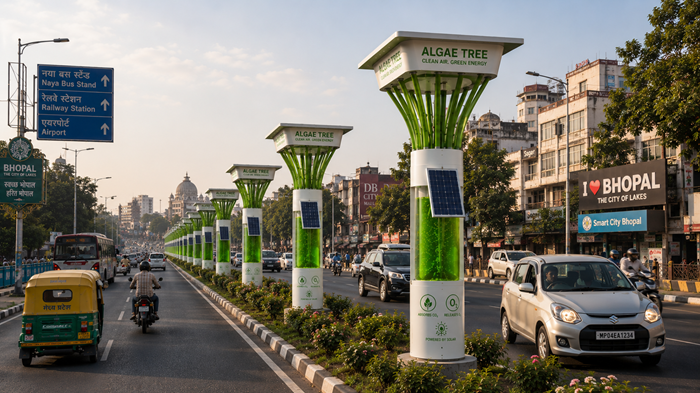
The algae tree is one of the most fascinating environmental technologies to emerge in India in recent years. It combines biology, renewable energy, and engineering into a compact system designed for crowded cities.
However, it should be viewed with both optimism and realism.
No machine can replace the beauty, biodiversity, cooling effect, wildlife habitat, and ecological importance of real trees.
At the same time, if algae-based systems genuinely help clean polluted urban air in places where planting trees is impossible, they could become a valuable addition to the fight against climate change.
Perhaps the real lesson is this:
The future of cleaner cities may not be about choosing technology or nature.
It may be about finding smart ways for both to work together.