The Surprising Technology Being Used to Pull Carbon Directly From the Air
Climate change has become one of the biggest challenges facing humanity. As global temperatures continue to rise, scientists and engineers around the world are searching for new ways to reduce the amount of carbon dioxide (CO₂) in the atmosphere. While renewable energy and electric vehicles are helping reduce future emissions, a surprising technology is now gaining attention for its ability to remove carbon that has already been released into the air.
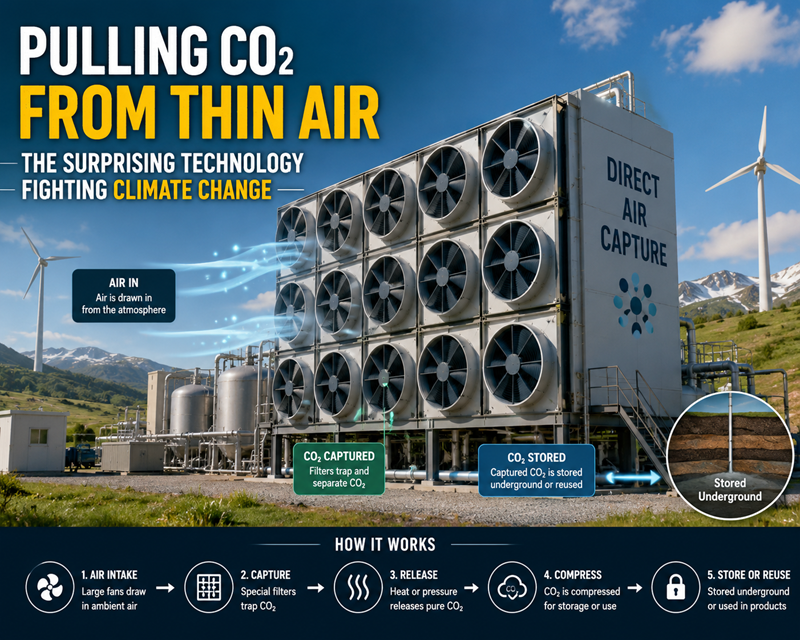
This technology is known as Direct Air Capture (DAC), and it works much like a giant vacuum cleaner for the atmosphere.
What Is Direct Air Capture?
Direct Air Capture is a process that removes carbon dioxide directly from the air. Large machines use powerful fans to pull air through special filters that trap CO₂ molecules. Once captured, the carbon dioxide can be stored deep underground or used in industrial applications.
Unlike traditional carbon capture systems that collect emissions from factories or power plants, DAC can remove carbon from anywhere because it works with the surrounding atmosphere itself.
How Does It Work?
The process is surprisingly simple:
- Giant fans draw air into the machine.
- Air passes through chemical filters designed to capture CO₂.
- The captured carbon dioxide is separated from the filters using heat or pressure.
- The purified CO₂ is compressed.
- It is either stored underground or reused in products such as synthetic fuels and construction materials.
Although the concept sounds futuristic, several companies are already operating commercial-scale facilities.
Why Is This Technology Important?
Even if the world stopped producing carbon emissions today, billions of tons of CO₂ would remain in the atmosphere for decades. Scientists believe removing some of this existing carbon may be necessary to meet international climate goals.
Direct Air Capture offers several potential benefits:
- Reduces atmospheric carbon dioxide levels.
- Helps offset emissions from industries that are difficult to decarbonize.
- Supports efforts to reach net-zero emissions.
- Can work alongside renewable energy and conservation efforts.
For this reason, many climate experts view DAC as an important tool rather than a complete solution.
The World’s Largest Carbon-Capturing Facilities
Several countries are investing heavily in Direct Air Capture technology.
Some of the most notable projects are located in Iceland, where captured carbon is mixed with water and injected into underground volcanic rock formations. Over time, the carbon reacts with minerals in the rock and turns into stone, permanently removing it from the atmosphere.
Other projects are being developed in North America, Europe, and the Middle East as governments and private companies race to scale up the technology.
The Challenges Ahead
Despite its promise, Direct Air Capture faces significant obstacles.
High Costs
Removing carbon from the atmosphere remains expensive. Current estimates suggest that capturing one ton of CO₂ can cost hundreds of dollars.
Energy Requirements
The machines require electricity to operate. If that electricity comes from fossil fuels, some of the environmental benefits may be reduced.
Scale
Human activities release tens of billions of tons of carbon dioxide every year. To make a major impact, thousands of large DAC facilities would need to be built worldwide.
Researchers are working to improve efficiency and lower costs, making the technology more practical for widespread adoption.
Could These Machines Help Fight Climate Change?
Many scientists believe the answer is yes—but with an important caveat.
Direct Air Capture should not replace efforts to reduce emissions. Instead, it should complement existing solutions such as renewable energy, energy efficiency, electric transportation, and forest conservation.
Think of it as cleaning up a spill after turning off the tap. Stopping emissions remains the priority, while carbon removal helps address the pollution that already exists.
What Does the Future Hold?
Investment in carbon-removal technologies has increased dramatically over the past few years. Governments, technology companies, and environmental organizations are funding research to improve Direct Air Capture systems and expand their deployment.
Experts predict that as technology advances and production scales up, costs will fall and carbon-capturing facilities will become more common around the world.
While these machines alone will not solve climate change, they represent one of the most innovative and ambitious attempts to clean Earth’s atmosphere.
Final Thoughts
The idea of pulling carbon directly from the air once sounded like science fiction. Today, it is becoming a reality. Direct Air Capture technology demonstrates how human innovation can help tackle some of the world’s most complex environmental challenges.
As countries search for ways to reduce global warming, giant carbon-capturing machines may become a familiar part of the landscape—quietly working to remove pollution from the atmosphere and create a cleaner future for generations to come.